

TRIART Inc. (head office: Iizuka City, Fukuoka Prefecture; CEO: Kentaro Imazu) has announced a non-contact medical information-sharing solution based on technology*1 from its XMIX remote medical system and begun experimental operation with Kumamoto University Hospital. It provides a more agile and secure information-sharing environment connecting inside and outside the hospital for medical sites facing various restrictions due to COVID-19.
Since the beginning of 2020, medical sites have continually faced the threat of COVID-19 and been forced to respond flexibly to many unexpected situations. They have continued daily medical care while adapting to unprecedented changes in the movement of people and materials, including staff assignments and routes, installation and relocation of hospital beds, and patients avoiding outpatient visits. To continue providing medical services without accidents in these circumstances, new approaches to information sharing beyond the traditional model are needed.
This system provides online consultations and an in-hospital smart intercom environment to address these challenges. Its key feature is secure information containment, with no need for specialized infrastructure or dedicated apps and no risk of information leaking outside the hospital or to unrelated parties. The environment meets the medical information guidelines*2 requirements for eliminating impersonation, eavesdropping and tampering, intrusion and disruption. It is implemented as follows:
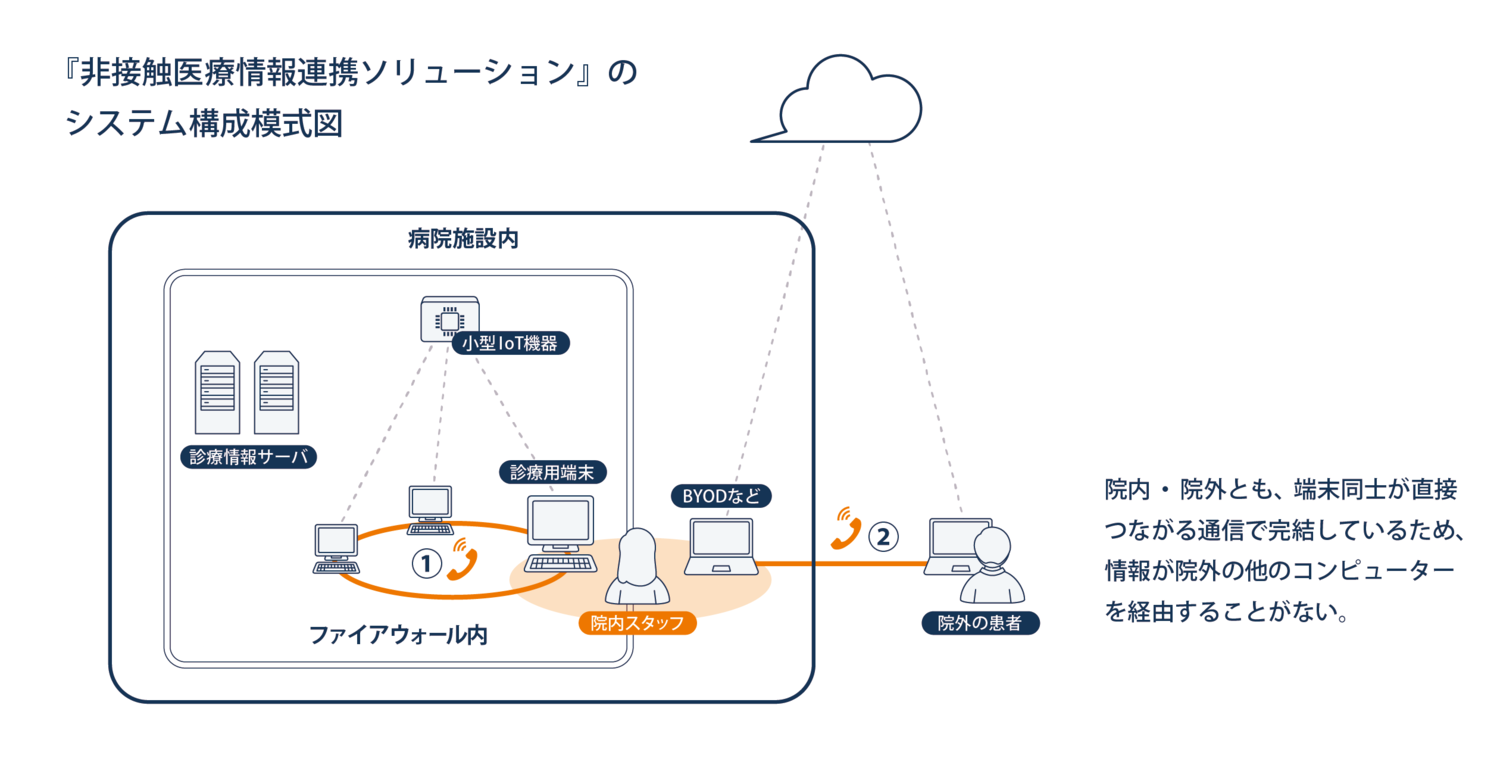
Small IoT devices are installed inside the hospital, enabling everything from administrator user management to communication among staff (smart intercom video calls) to take place entirely within the hospital without going through the internet (① in the diagram).
For online consultations with patients outside the hospital, the system contacts an external server before the call starts. Once a connection is established, it switches to direct communication between devices, so call content does not pass through a server or other computer (② in the diagram).
Both in and outside the hospital, communication starts in a standard web browser. Users can join immediately without special preparation, regardless of device type or operating system, whether on a PC or mobile device.
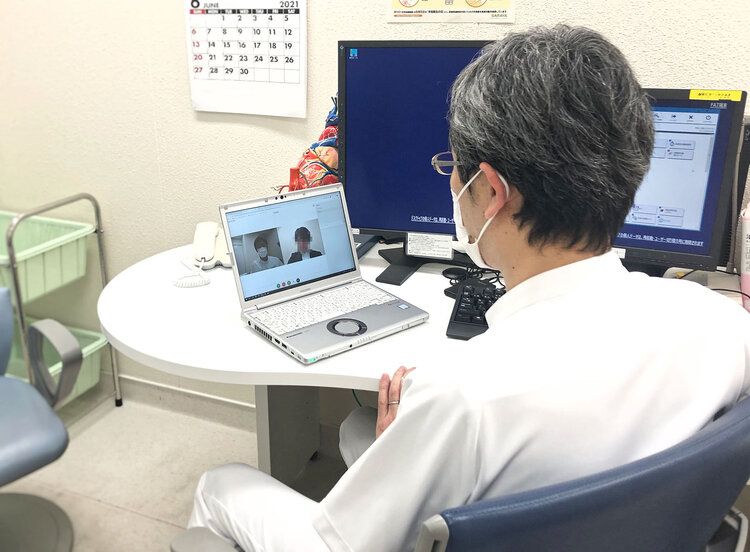
(Photo) Online consultation with a patient outside the hospital
This system provides agility for sharing information with restricted areas such as wards for infectious disease patients and for consultations with remote patients. Vaccines are expected to become more widespread and COVID-19 may subside in the near future, but the need for contactless communication revealed by these infection-control measures will not diminish and is likely to become even more common. In light of this, we plan to broaden the range of information that can be shared while maintaining and strengthening secure information containment, including by combining the system with TRIART secure camera technology*3. We also believe this system, proven in medical settings, can help solve challenges in manufacturing, local government, and other settings that handle large amounts of confidential information.
*1 XMIX remote medical system: A remote medical system that contributed to reducing disparities in emergency medical diagnosis by enabling secure, real-time information sharing. It has been in operation in Kumamoto Prefecture since 2010.
*2 Medical information guidelines: This system complies with Section 6.11, “Security management when exchanging medical information containing personal information with external parties,” of the Ministry of Health, Labour and Welfare Guidelines for the Security Management of Medical Information Systems, Version 5.1, January 2021.
*3 Secure camera technology: A secure camera solution jointly announced by TRIART and Toyota Motor Kyushu, Inc. in 2017. Secret sharing and non-internet communication eliminate the risk of video and still image leaks. It is used in many settings, especially manufacturing, under the name XCOA-CAM.