

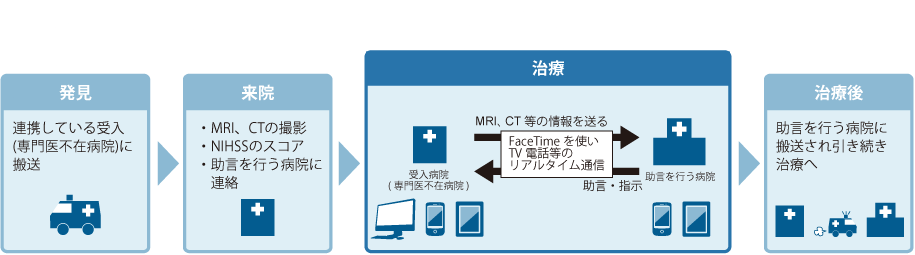
(Figure) Process from admission to transport or treatment
— Strengthening acute stroke care —
Under the national FY2012 supplementary budget, Kumamoto Prefecture developed its FY2013 Regional Healthcare Revitalization Plan to address local medical challenges, including securing physicians and regional medical collaboration. One aim of the plan is to strengthen acute stroke care in the prefecture.
Using the FY2013 Regional Healthcare Revitalization Plan, Kumamoto University Hospital (Kumamoto City, Kumamoto Prefecture; Director: Hidenobu Tanihara) and TRIART Limited (Iizuka City, Fukuoka Prefecture; Representative: Kentaro Imazu) jointly developed the XMIX remote medical diagnosis support system. We are pleased to announce that operation began on Friday, July 18, 2014 at six medical institutions in Kumamoto Prefecture to support emergency response for stroke patients.
XMIX is a remote medical diagnosis support system that began trials in June 2012 at Kumamoto University Hospital and Aso Medical Center (formerly Aso Chuo Hospital of the Aso City National Health Insurance). When a stroke patient is transported by ambulance at a time when no specialist is on duty, it contacts specialists at a remote location and lets them view the patients images on an iPhone or iPad. This groundbreaking system enables the receiving medical institution to treat stroke patients while receiving necessary advice from specialists. It has built a track record of helping save stroke patients who need especially rapid diagnosis and treatment.
Kumamoto Prefecture has expanded XMIX to six medical institutions in the prefecture to help save as many stroke patients as possible. The participating institutions are listed below. We plan to expand the system to other medical institutions as well.
● Participating medical institutions (in Japanese alphabetical order)
Aso Medical Center
Kumamoto Medical Center
Kumamoto Saishunso Hospital
Kumamoto University Hospital
Minamata City General Hospital
Yamaga Central Hospital
■ System Overview
XMIX consists of iOS devices such as iPads and iPhones and a dedicated server system. Information is shared using Apple FaceTime and a radiation image viewer developed specifically for this system. This enables consultation with specialists at remote locations. Each communication route is protected by TRIART proprietary technology.
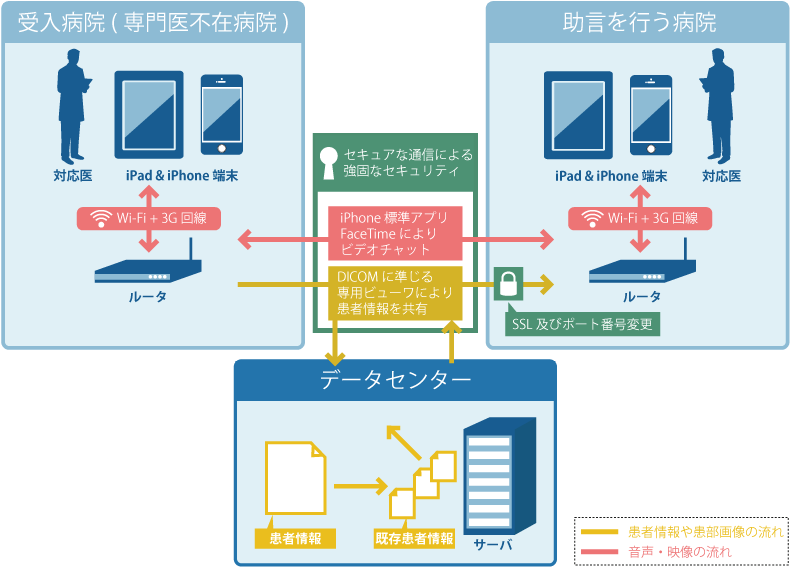
(Figure) System configuration
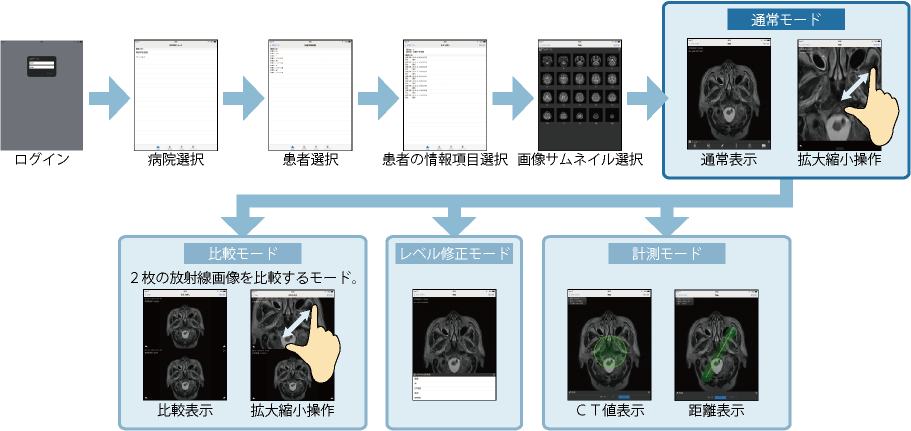
(Figure) Example system screen
■ System Features
XMIX has carefully selected functions so it can be deployed without modifying existing medical information systems used by each institution. Remote medical systems have previously been limited to large hospitals because of development costs for connecting to in-hospital systems and operational challenges. XMIX was designed for easy deployment at small and midsize medical institutions without specialists on site.
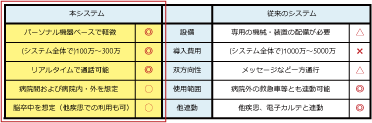
(Table) Comparison with conventional systems
■ Security
XMIX achieves the security level required by the Ministry of Health, Labour and Welfare Guidelines for the Security Management of Medical Information Systems, Version 4.2 (October 2013), by applying TRIART Limited XCOA (Cross Core) technology. This technology provides encryption and segmented transmission routes, encryption of communication content, time-limited caching on devices, and authentication. As a result, even if an iOS device is lost or stolen and obtained by someone other than an authorized person, the information cannot be viewed. Information also cannot be extracted even if the device is hacked.
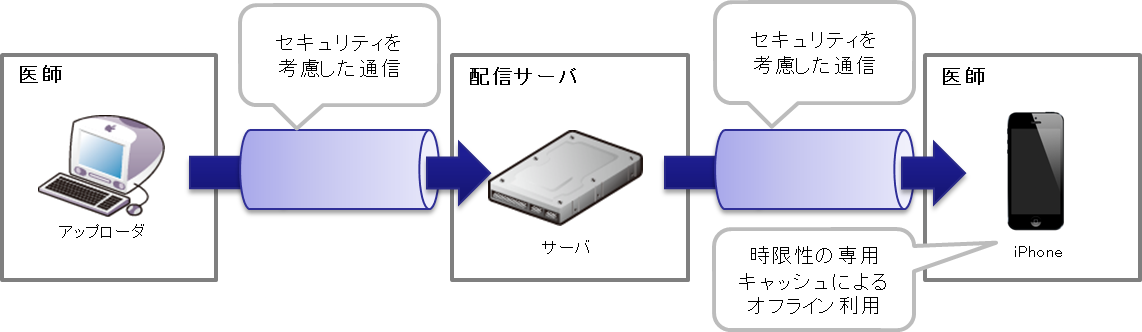
(Figure) Security overview
*Company names, product names, and service names mentioned are trademarks or registered trademarks of their respective companies.