

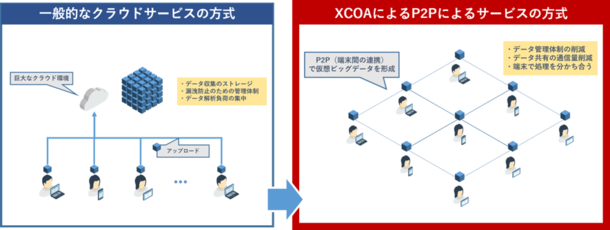
(Figure) Reference 1: From big data collected and managed in the cloud to secure mutual data use through P2P device collaboration
TRIART Inc. (pronounced Try Art; head office: Iizuka City, Fukuoka Prefecture; President and CEO: Kentaro Imazu; hereinafter TRIART) has implemented a technology that uses XCOA (Cross Core) to analyze massive datasets securely in big data operations involving large volumes of data or confidential data from enormous numbers of users. This is expected to enable virtual big data and computational processing through device collaboration. We will continue testing this technology and expanding it into fields that need advanced security while effectively using data, such as healthcare and finance, which handle large amounts of confidential and personal information, and industrial IoT in automotive manufacturing and construction, which requires large-scale, high-speed data processing.
In general internet services such as web services, user contract information, personal information, and behavioral histories are usually collected on cloud servers based on trust in the operating organization and must be managed and operated according to established rules. Service providers can analyze this collected data using statistical processing and AI to find overall trends and new insights. However, because information is handled based on trust, there remains a risk of human error leading to information leaks or tampering. Strict management is difficult, as are maintenance of data services and monitoring of operations.
Cloud services also have limits in connection speed for accessing data and CPU processing capacity. Data processing involving risks, such as financial payments using electronic money and autonomous driving, is important and requires real-time performance. Cloud systems that enable the large-scale server processing needed for such operations are very expensive, and service infrastructure may be impossible to provide in developing countries without robust infrastructure. Blockchain-based services without a central system have therefore spread rapidly in recent years, but are not necessarily suited to handling massive datasets.
To address these challenges, TRIART developed P2P big data processing technology that does not centralize data from users devices on a server. Instead, data is distributed across devices and connected by software, virtually combining each users device as part of the data to form big data. By also using the CPUs of participating devices to distribute processing, the system enables large-scale calculations through participation and can run massive analyses. Software can therefore build a high-performance data-processing infrastructure at low cost (Reference 1).
To make effective use of this system, TRIART researched computer collaboration technology (Cross Computing Architecture, XCOA), combining secure data encryption with P2P network formation. We succeeded in developing programs for secure, serverless use of massive datasets by consolidating P2P collaboration between devices while maintaining strong security measures.
Depending on the data being collected, conventional collection of vital data in healthcare, for example, required more than 1 GB of data per day. If data for 100 people were sent to a server, the receiving side would need to process about 100 GB of communications. The technology developed here does not require time to collect data over a network, reducing time and costs for processing that requires an immediate response. Because aggregation calculations after collection are also unnecessary, we expect faster processing and shorter turnaround than conventional centralized big data formation, enabling real-time services.
In a practical demonstration, data from multiple cameras and sensors was processed through a P2P data network without aggregating spatial information on a server. This successfully judged risks hidden in a specific space through participant collaboration without collecting the data (Reference 2). It also enabled use and computation on personal information without collecting medical or inspection data in a central repository.
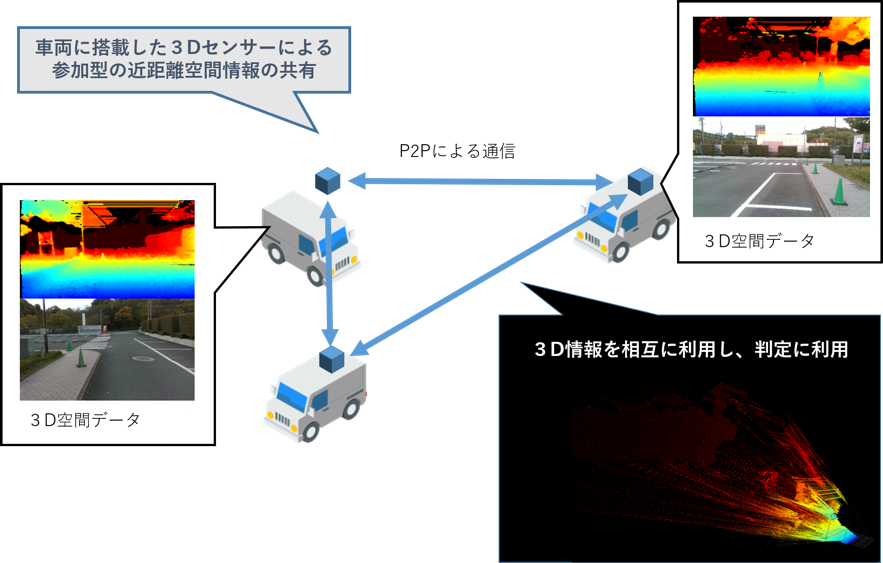
(Figure) Reference 2: Spatial risk management through mutual use of 3D data among vehicles
■ Benefits of this technology
(1) Process large-scale video data and analyze confidential information such as DNA and vital data that must not be leaked
(2) No need to build massive servers or network infrastructure even as the number of devices and volume of data grow
(3) Reduce storage and communication costs for IoT and confidential data operations
(4) Combine CPU capacity across devices to enable large-scale analysis that was previously impossible
(5) Build infrastructure that ensures strong security and prevents information leaks through software deployment alone
Blockchain has brought attention to distributed ledgers and networks, in which devices share information through P2P communication without depending on servers or a central system. This system is one applied technology that brings such technologies into real-world use. It is expected to be useful across many industries, including healthcare and finance.
【About TRIART Inc.】 (http://triart.co.jp/)
TRIART is an IT company focused on technology creation, with research and development of new IT technologies and consulting as its main businesses. The company has many proprietary technologies, including AI data processing, image application processing, and network security. It has provided numerous network and information security solutions and solved many difficult market problems. Its security research and development capabilities for protecting information, especially encryption and data-distribution technology XCOA (Cross Core), are highly regarded. They underpin solutions for healthcare, including XMIX, a trusted remote medical diagnosis support system, as well as information security for major companies.
TRIART Inc. Company Profile
President and CEO: Kentaro Imazu
Head office: CIRD, 680-41 Kawazu, Iizuka City, Fukuoka Prefecture, Japan
Established: January 2003
Capital: JPY 10,000,000
Business activities: IT solutions / Information design
URL:http://triart.co.jp/