

TRIART Inc. (head office: Iizuka City, Fukuoka Prefecture; CEO: Kentaro Imazu; hereinafter TRIART) and Toyota Motor Kyushu, Inc. (head office: Miyawaka City, Fukuoka Prefecture; President: Osamu Nagata; hereinafter Toyota Kyushu) will begin operating a priority traffic-control system for long-distance automated guided vehicles used outdoors at the Miyata Plant, where Lexus vehicles are manufactured. Vehicles equipped with participating devices form a ring network through direct communication and confirm safety with one another. The plan is to operate a single system for monitoring outdoor long-distance vehicles, controlling priority at intersections, and confirming safety with pedestrians.
Manufacturing plants in many industries increasingly use automated guided vehicles (AGVs) to transport products and parts within their premises. AGVs generally follow guidance such as magnetic lines, QR codes, or RFID and have onboard sensors to avoid collisions. They are essential in many areas, including large automotive factories, as a way to reduce the burden on workers and improve productivity. However, complex layouts involving crossings or merging have so far required scheduled routes with fully managed travel order, and even then only when all AGVs could be centrally managed on the same system from one manufacturer.
TRIART has successfully developed a priority traffic-control system that lets vehicles autonomously decide which has priority at intersections, designed for Toyota Kyushu Miyata Plant, where AGVs from multiple manufacturers operate using different data formats and communication specifications. Starting in January 2022, a similar system is scheduled to begin monitoring long-distance outdoor AGVs on part of the Miyata Plant site.
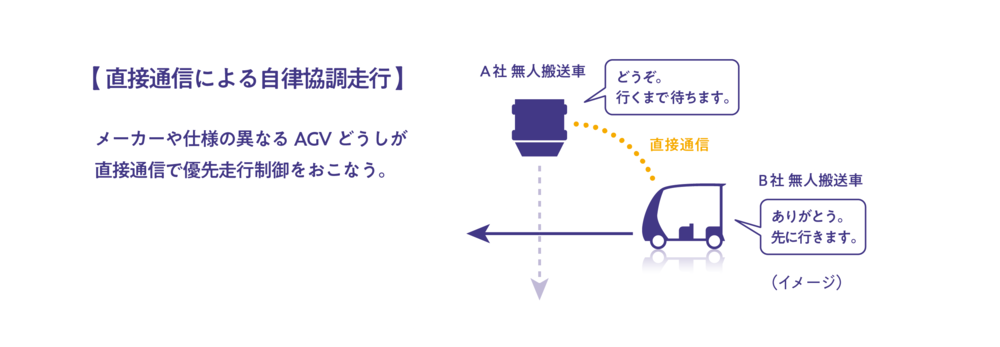
This is a dialogue system in which AGVs from different manufacturers communicate directly without infrastructure. It is a groundbreaking architecture that enables autonomous coordination while handling differences in the specifications of vehicles from each manufacturer, pedestrian devices, and potentially road equipment in the future. The system is made possible by two main original developments:
[1] Build a ring network that devices can join and leave
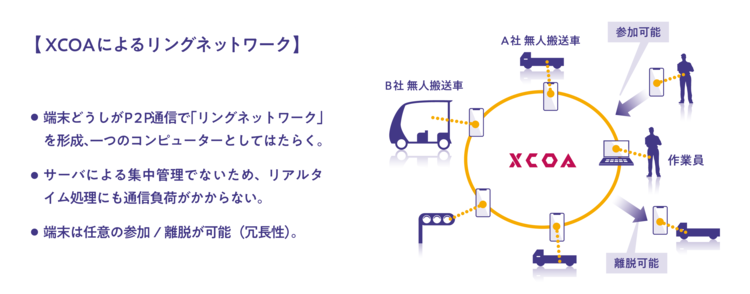
TRIART original distributed computing technology XCOA* is installed as an agent on devices such as vehicle smartphones, worker smartphones, and administrator PCs. The devices form a ring network connected through direct peer-to-peer (P2P) communication. The ring is an autonomous network in itself and also acts as a single computer running programs such as the priority judgment logic used in this system. Unlike centralized server monitoring and control, it places no communication load on real-time or continuous processing. Its redundancy also maintains communication when devices join or leave at any time.
[2] Build functions to link devices with different specifications
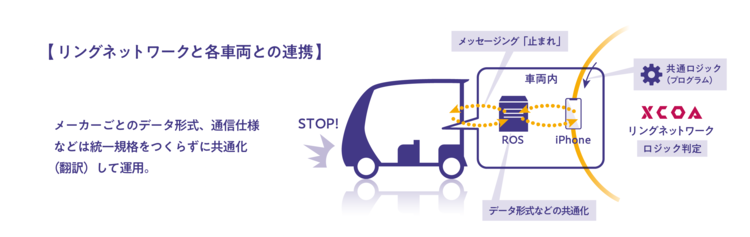
Results processed on the ring network, such as stop commands, are sent as messages to AGVs and their management equipment to control each device, for example by applying vehicle brakes. Depending on the recipient, messages may pass through a PLC (programmable logic controller) or ROS (Robot Operating System) machine. Differences in data formats and communication specifications are standardized (translated) here, allowing the common logic on the ring network to make the decisions and absorb those differences.
Because the ring network at the core of this system is based on P2P communication, it avoids risks and costs caused by concentrating load on a server. As collaboration expands by adding rings according to the number and roles of participating devices, the strengths of distributed computing will become even more apparent at scale. The system also reduces the social cost of developing and maintaining software for unified standards and allows flexible design according to the application and environment.
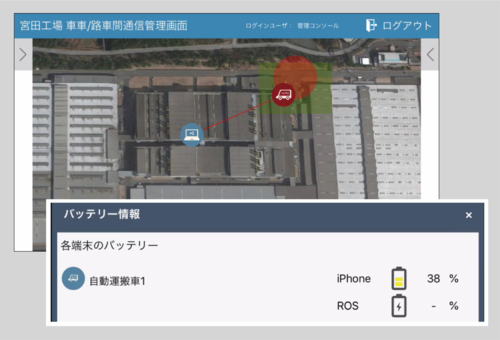
(Top photo) Management screen showing participating devices on the ring network
(Bottom photo) Real-time status of each device, including battery information
Current operation focuses on a small number of vehicles and collaborating workers, but we plan to evolve the system so people walking around the factory and road equipment can participate as well. Outdoors at the Miyata Plant, ten types of transport vehicles carry parts across a 2.5 km site. They travel at different times and coexist with pedestrians and entering and exiting trucks, creating diverse crossing and merging patterns. If all these vehicles could be automated and their movement controlled through mutual decisions, without centralized management of pedestrians or equipment, distributed computing could one day support general transportation infrastructure used by autonomous vehicles.
When new social infrastructure is introduced, one option is a centralized approach that replaces all existing systems. Another important perspective for future information technology is to connect existing systems, maintain performance, and avoid excessive concentration of information and authority. TRIART will continue exploring these possibilities in various fields using our proprietary technologies, while Toyota Kyushu is proactively working to generalize new production technologies born from real challenges on site. Building on this practical deployment, we will continue research and development to evolve this system into a valuable technology for society.
* Distributed computing technology XCOA (Cross Computing Architecture) is a registered trademark and proprietary design technology of TRIART Inc. (Japanese Patent Nos. 6427697 and 6427702; international patent applications pending).
Full press release